Food vending
Automatic vs Semi-Automatic Cotton Candy Machines: Staffing Compared
Compare CT-103 manual stick handling with CT206 and CT606 automatic feeding. Review the complete serving cycle, staffing, cabinet dimensions and service tasks before choosing.
Start with who handles the stick
Choose a semi-automatic cotton candy machine when your staffing plan covers manual stick insertion and collection. Choose an automatic stick-feed cabinet when customers need to select, pay and collect without staff inserting a stick for each normal order. Both need someone responsible for replenishment, cleaning and faults. Start with those responsibilities before comparing the equipment price.
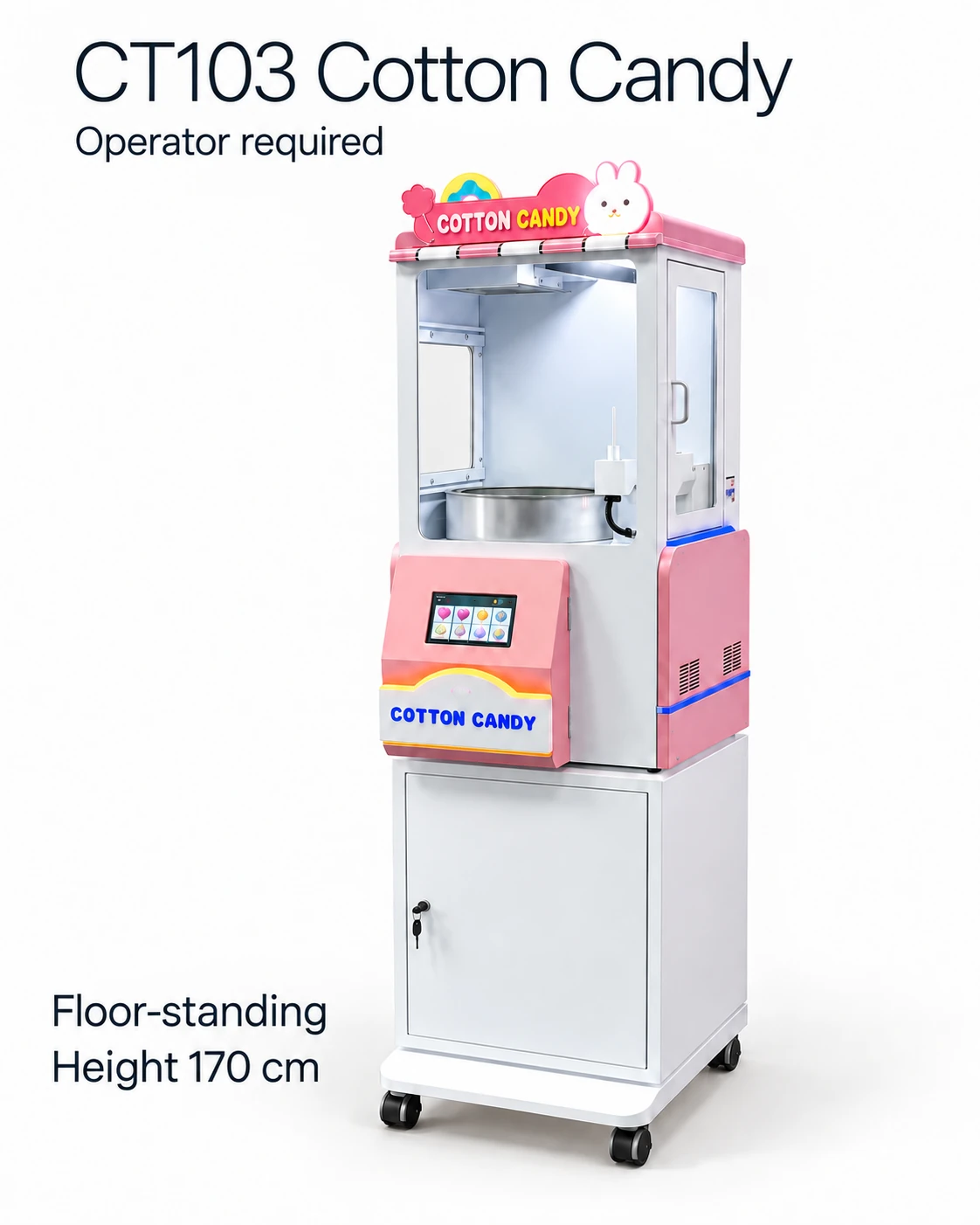
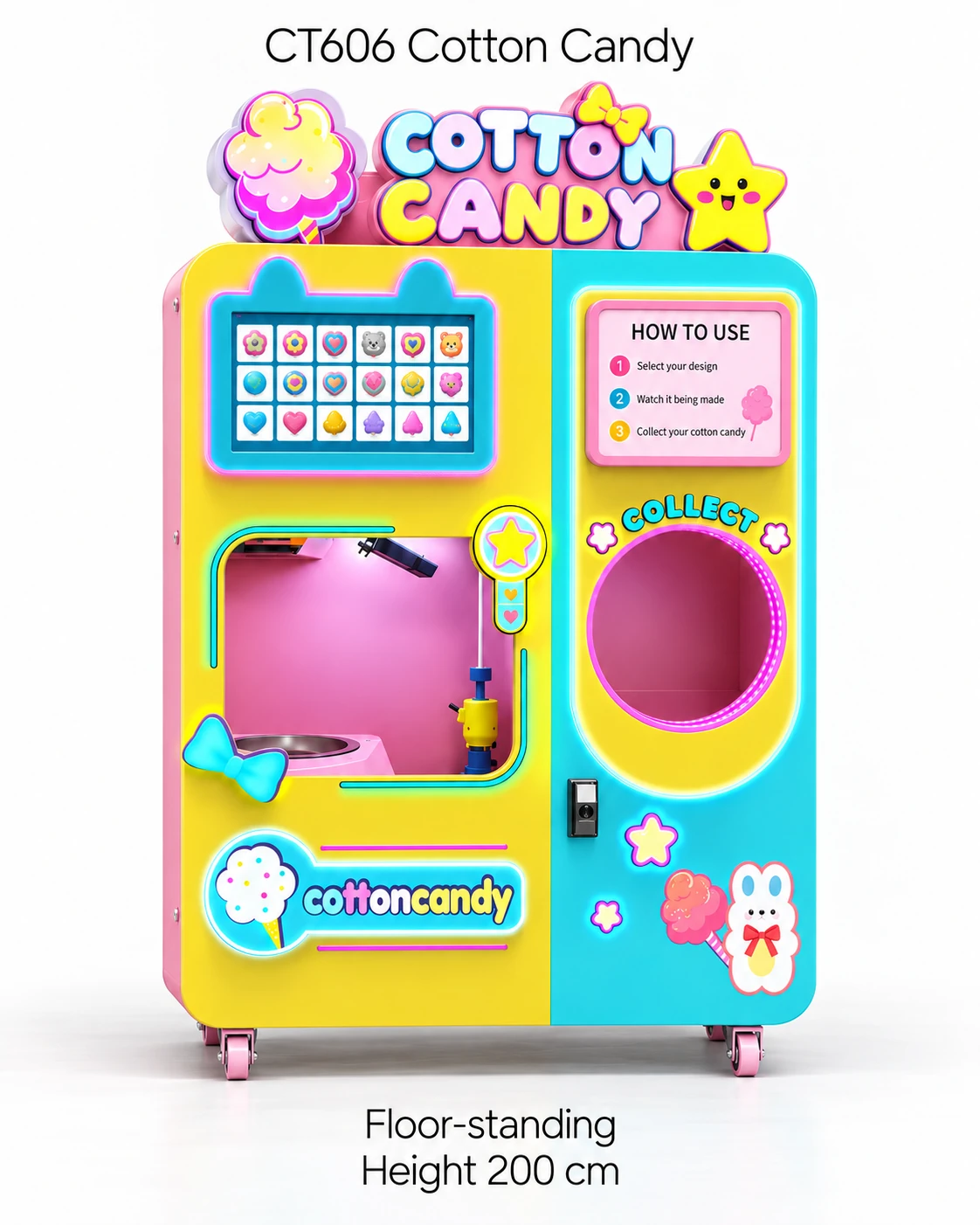
Our CT-103 reference shows a customer opening the right-hand door, inserting a paper stick, waiting for production and removing the finished candy. The CT206 and CT606 reference sheets describe automatic stick feeding and collection from a pickup compartment. Red Rabbit also identifies CT-103 as semi-automatic in its official range. Confirm the exact sequence on the version offered in your quotation.
Compare a documented configuration with its open questions
The following figures come from the supplied, model-labelled reference sheets. They describe three specific reference configurations. They are useful for shortlisting; the ordered build still needs a dimensioned drawing and written configuration. In particular, a picture of a compact cabinet on a stand does not provide a separate countertop specification.
Swipe across to compare all columns.
| Reference model | Documented workflow | Supplier-listed cabinet | Confirm before ordering |
|---|---|---|---|
| CT-103 · Compact Semi-Automatic | Manual stick insertion and removal; automatic candy making. | 170 × 49 × 58 cm as printed; pictured with a lower stand. | Separate cabinet/stand dimensions, side-door clearance, approved user handling and interlocks. |
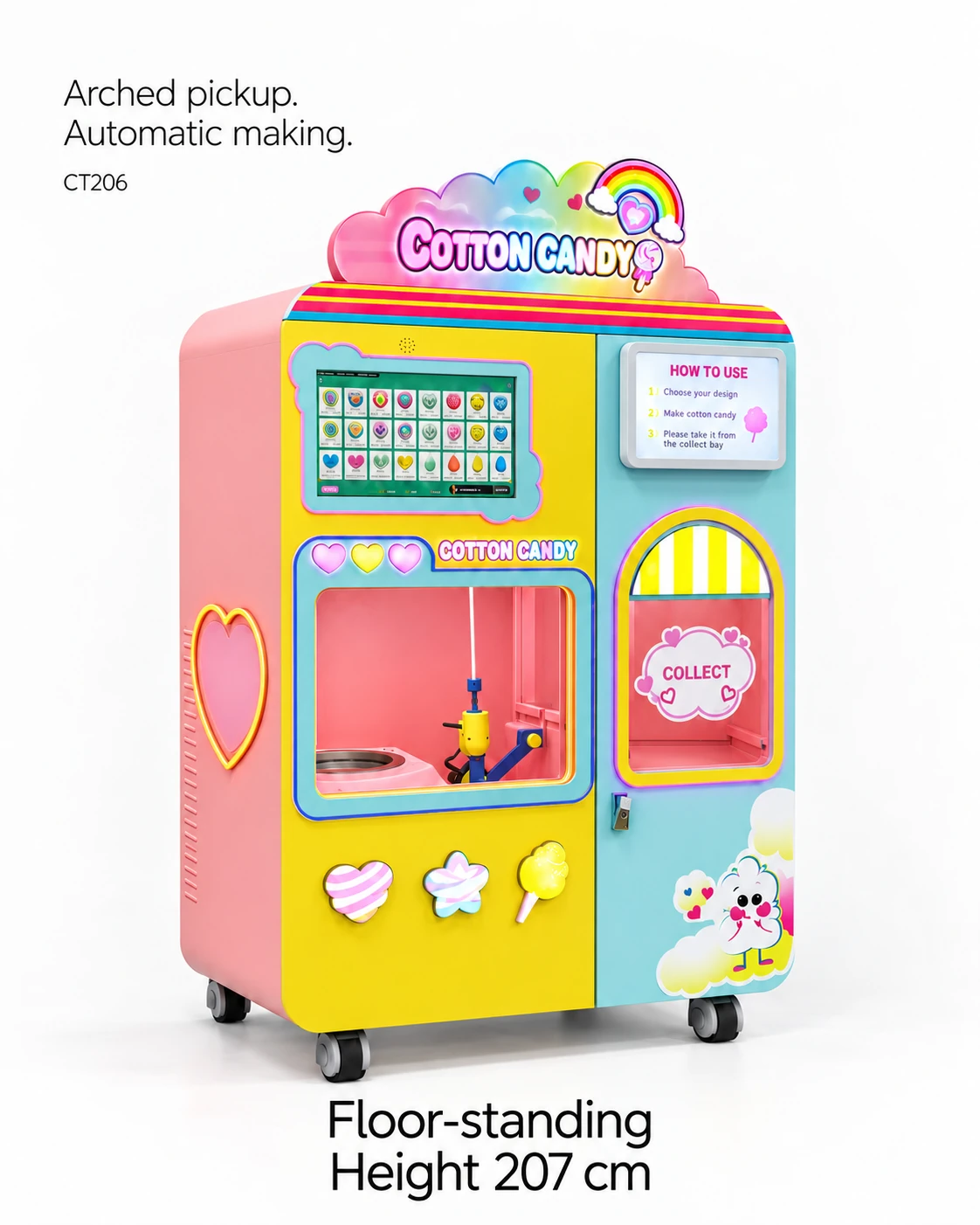
| CT206 · Arched Automatic | Automatic stick feeding; pickup compartment. | 135 cm front width × 71 cm depth × 207 cm height. | Current enabled menu, refill yield, loading access and complete pickup sequence. |
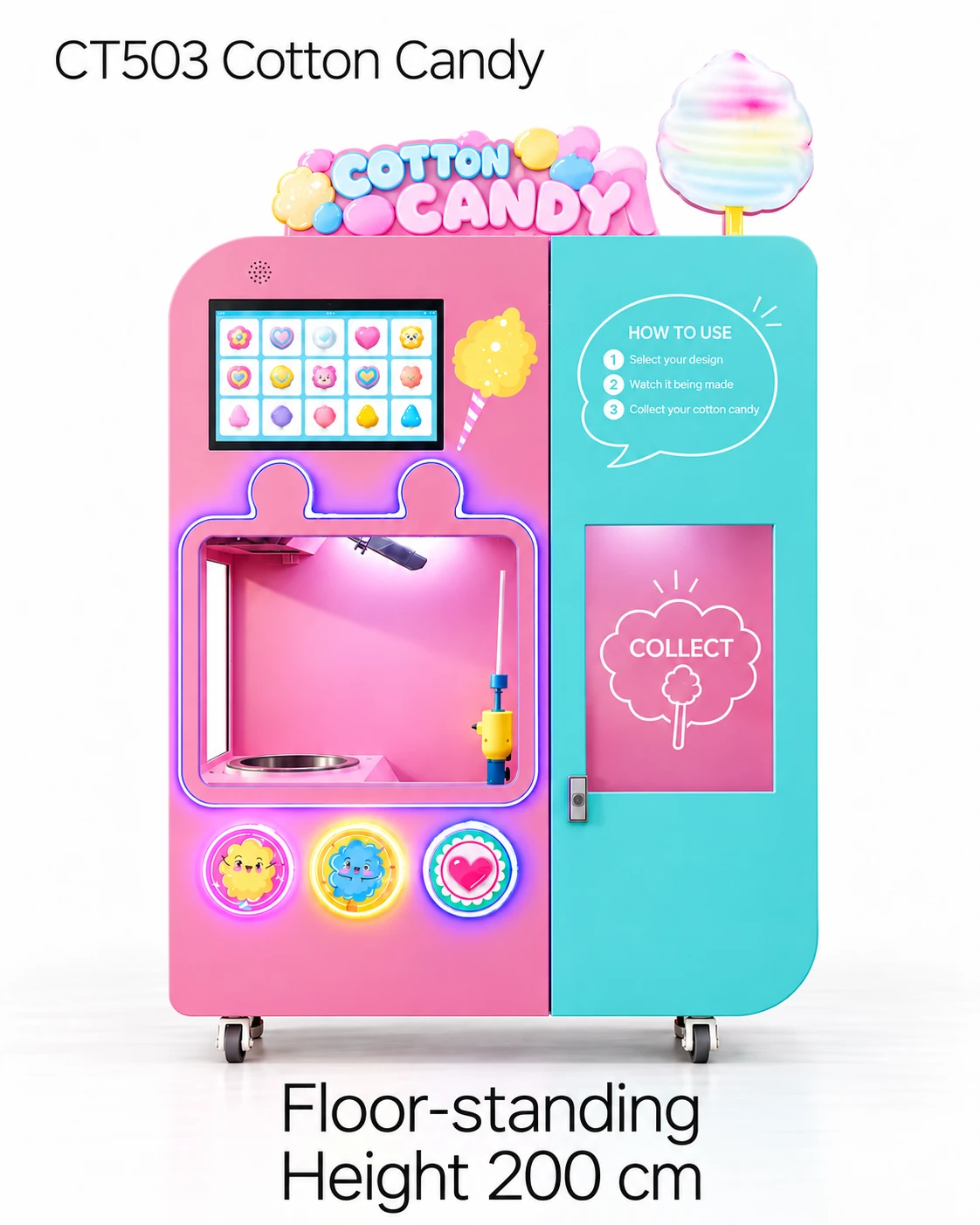
| CT606 · Colorful Automatic | Automatic stick feeding; pickup compartment. | 130 cm front width × 65 cm depth × 200 cm height. | Current recipe/software revision, portion size, refill plan and service access. |
Supplier-listed dimensions are not measured installation clearances. CT-103 source does not label every axis; do not treat its stand-inclusive listing as countertop-only dimensions. Shape and yield claims vary across source revisions, so they are not used as a ranking here.
Compare one complete serving
For a staffed concession, include payment, manual stick handling and the handoff to the customer in the observation. For an automatic cabinet, follow selection, payment, making and collection through to readiness for the next customer. Timing only the making stage leaves out work that affects queues.
- CT-103 record: payment owner; stick insertion; candy making; manual removal; customer handoff; readiness for another order.
- Automatic-cabinet record: selection and payment; automatic stick feed; candy making; collection cue; customer pickup; readiness for another order.
- Shared service record: replenishment, cleaning, failed-vend response and technical escalation, each with a named owner.
Match the workflow to your venue and staffing
For a staffed retail counter, make manual handling part of the demonstration: where does the stick come from, who inserts it, and how is the finished candy collected? Review the approved user instructions and door protection before planning family use. A scene showing children enjoying the product does not establish that children should operate the preparation area without assistance. Cover attendant breaks as well as selling hours.
For a mall route or several venues, ask an automatic-machine demonstration to include a refill and a recovery from an interrupted vend. Record what staff must do, what customers see and how an incomplete order is resolved. An attractive front window is useful only if the operating routine fits the people available at the site. Confirm how quickly the service owner can reach each location.
Compare refill work, not just headline capacity
Request a test using the intended sugar, paper sticks and enabled recipes. Record starting stock, completed servings, waste and any interventions. Sugar capacity, stick capacity and usable servings answer different questions; one consumable can run out while another remains. A shape library describes menu choice, not measured output per shift.
Allocate time for loading ingredients, checking stock and following the model cleaning procedure. For a distributor, include an illustrated handover routine and confirm which consumables a customer can source locally. Repeat the same trial on the proposed batch configuration before treating the pilot result as representative of every unit.
Separate installation and electrical figures
Mark the cabinet, open doors, customer collection area and service approach on the site plan. Check the receiving route and the packed dimensions separately. Ask which parts are removed for shipping and who reinstalls them. A machine fitting inside a marked rectangle does not prove that it can be refilled or cleaned there.
Power labels need the same discipline. Fun Vending publishes separate standby and operating figures for its T30; Caiyunjuan identifies a maximum-power figure for CT580mini. Those are different machines, not substitute ratings for our CT references. Ask for the quoted unit’s electrical label, peak demand, input voltage version, frequency, plug and installation requirements before arranging the supply.
Turn the shortlist into a demonstration and quote
Use the same task sheet for both offers. Separate per-serving, scheduled-service and exception tasks; record the owner, frequency, observed time and instruction reference. Attach the included training, documents and support scope to the quotation.
An operator can begin with a venue plan and an intended staffing routine. A distributor should add destination groups, quantities and the configurations expected to repeat. Put differences in payment hardware, language, artwork, recipe package and service materials on separate quotation lines so that a mixed batch remains understandable.
Send your preferred model, destination, available space and who will handle daily service. We can organize the supplier questions around that brief and request the relevant configuration details. Use the resulting proposal to compare the complete equipment scope, consumables, packing and support responsibilities before selecting quantities.
CHECK THE REFERENCES
Sources
- Compact Semi-Automatic Cotton Candy Machine — CT-103 reference
Supplier-labelled reference sheet and manual stick-handling sequence; countertop-only dimensions are not supplied.
- Arched Automatic Cotton Candy Machine — CT206 reference
Supplier-labelled automatic stick-feed configuration and cabinet dimensions.
- Colorful Automatic Cotton Candy Machine — CT606 reference
Supplier-labelled automatic stick-feed configuration and cabinet dimensions.
- Red Rabbit official cotton candy range
Identifies CT-103 as semi-automatic and lists CT-206/CT-606. Current recipe and yield statements differ from local reference revisions and are not adopted.
- Fun Vending T30 official specification
Example of separately labelled standby and operating power for a different model; values are not transferred to CT-103.
- Caiyunjuan CT580mini Blue official specification
Example of maximum-power terminology on a different automatic machine; not a specification or certification match for our CT models.
PUT THE GUIDE TO WORK
Shortlist the right cotton candy workflow
Send your venue plan, destination, quantity and daily staffing arrangement. Ask for a model-specific demonstration and a quotation covering configuration, consumables and service needs.
Build my equipment brief