Claw & prize machines
Single-Player vs Four-Player Claw Machines: Space and Refill Work
Compare a single-player and four-player claw cabinet by usable stations, player access, prize fit, control independence and refill workload.
Choose usable stations rather than the largest player count
Choose a single-player claw machine when one accessible prize station suits the location and staff routine. Consider a four-player mini claw when all four positions can be reached, stocked and supported and the venue can use the extra stations. Compare daily tasks and payment mapping as well as the player count.
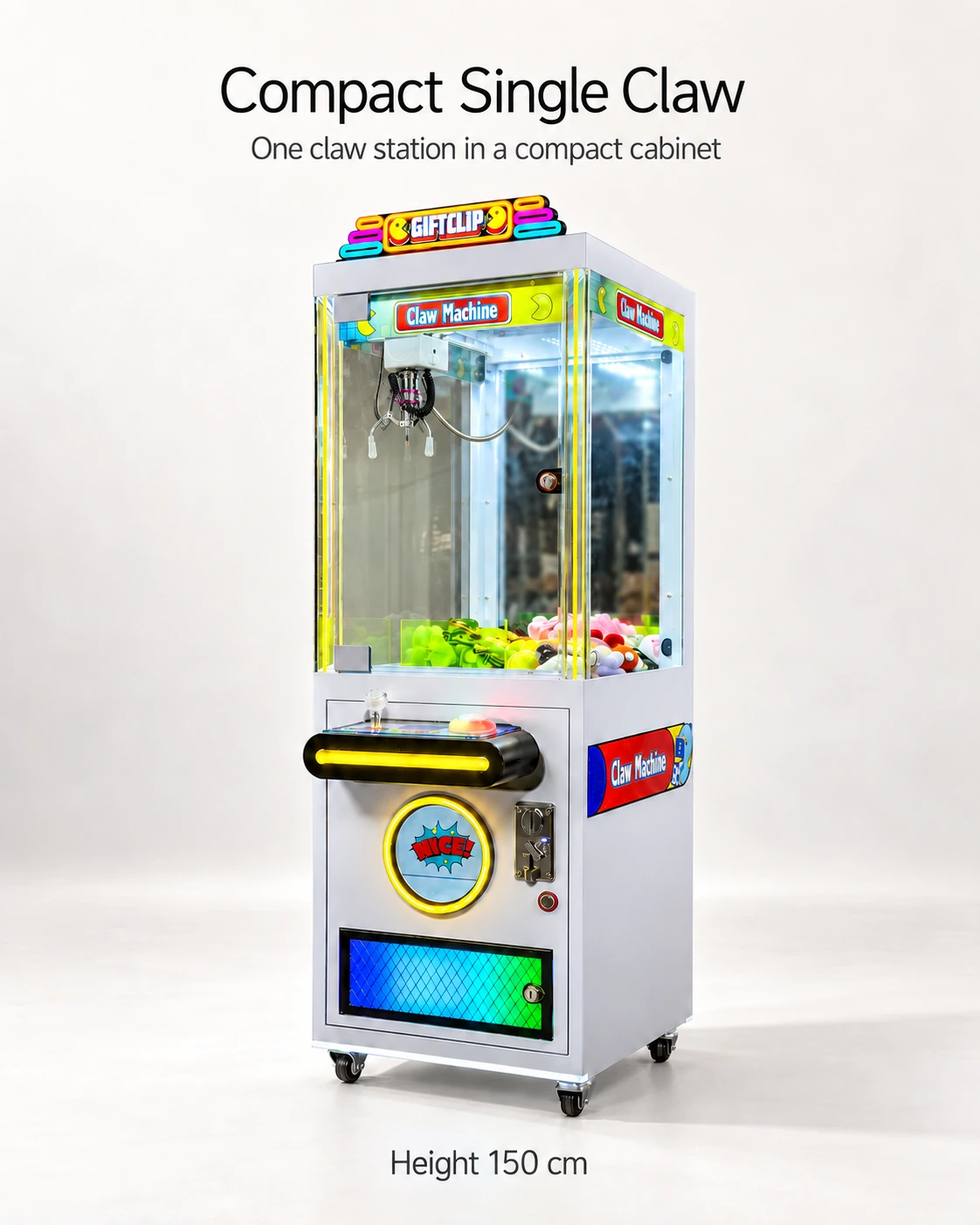
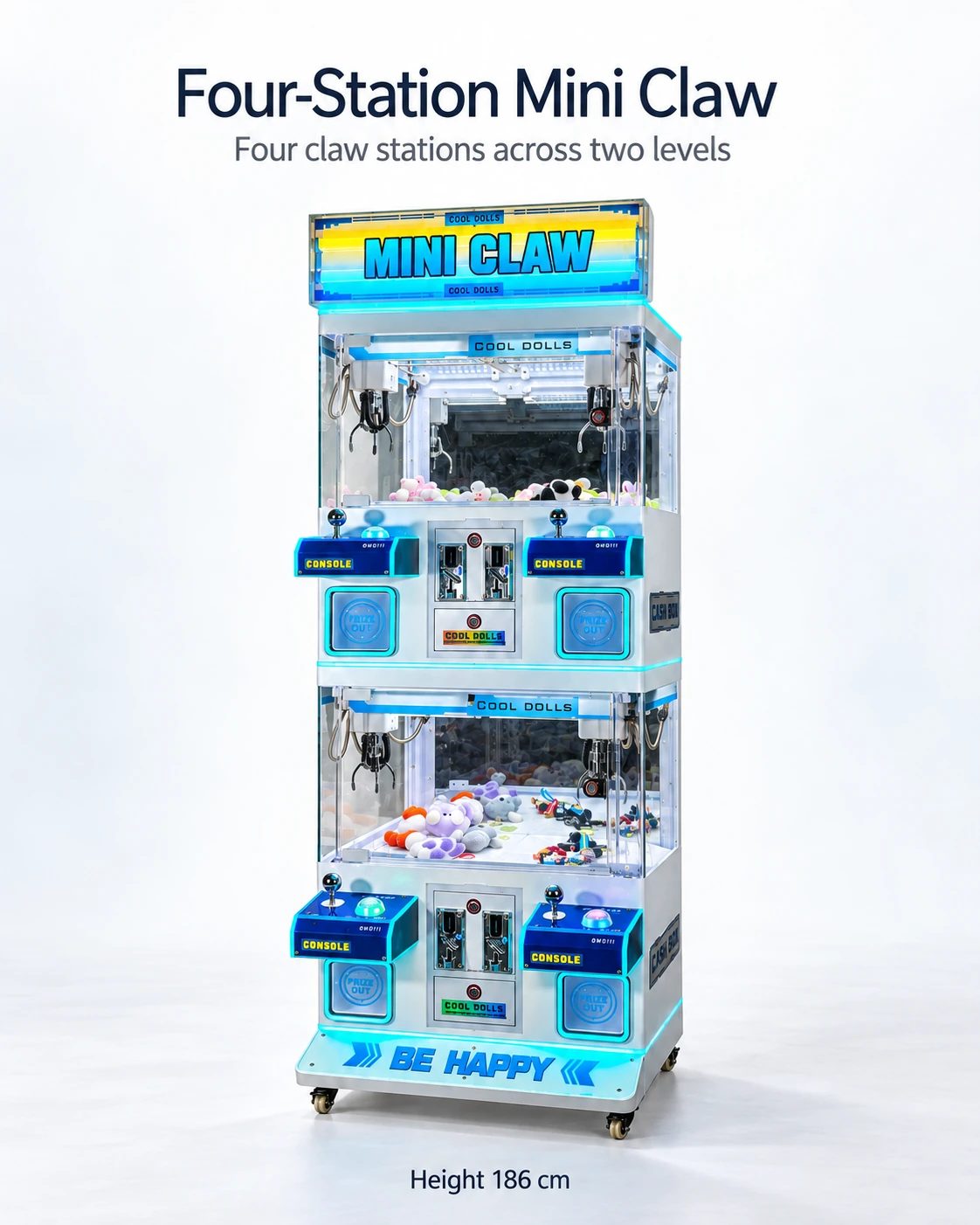
The supplier lists one station and 50 × 61 × 150 cm for the Compact Single Claw, and four stations and 72 × 55 × 186 cm for the Blue Four-Station Mini Claw. The blue cabinet places stations on upper and lower levels. Add their control heights, retrieval access and shared or independent payment functions to the comparison.
Build a station-level comparison matrix
Use one row per operating station. A blocked lower outlet or hard-to-reach upper chamber then appears as a specific layout issue, rather than disappearing inside a cabinet-level score. Keep any unanswered access or control function visible in its row.
- Player access: control height, view of the prize, retrieval approach and simultaneous-player overlap.
- Prize fit: approved sample, claw version, bed arrangement and usable outlet dimensions for that specific station.
- Daily work: inspection, refill, reset, cash or token handling and cleaning access.
- Control independence: which settings and counters belong to one station, and which are shared.
- Fault effect: whether one station can be taken out of service while the others remain available, as demonstrated for the proposed version.
Measure refill work with a small trial
Compare the same refill sequence: open, inspect, arrange the same approved stock, clear the outlet and lock up. Time each step during the demonstration or trial. Add staff travel and access time from your venue separately; that part of the workload depends on the location.
For a planning estimate, write daily work as access time plus the sum of station inspection times plus refill time for the prizes actually replaced. Add cleaning, reconciliation and fault reporting. Four stations do not necessarily create four times the work because some tasks are shared, but shared access does not remove the need to inspect every station.
A hypothetical workload comparison
Assume a planning trial gives a single station two minutes of opening and closing work, one minute of inspection and three minutes of prize arrangement. That visit totals six minutes. Now assume a four-station cabinet has the same two-minute shared access step, one minute of inspection per station and three minutes of arrangement per station when all four need refill. The hypothetical visit totals eighteen minutes.
Keep those hypothetical task times as editable worksheet inputs. Replace them with timed demonstrations and venue records. A visit replacing stock in only one station has a different task mix, while an awkward upper-station approach can reduce the benefit of shared access.
Check whether the venue can use the capacity
Mark all proposed player positions on the floor, then ask the venue to review waiting, circulation and prize pickup. Observe busy and quiet periods before predicting whether extra stations will be used. Record groups that pause, attempt to play or cannot approach. A cabinet with unused stations may still suit a broader prize assortment, but that is a different reason from needing concurrent play.
The supplier lists 70 W for the compact single model and 250 W for the blue four-station model; the rating basis remains to be confirmed. Compare the quoted build's operating and maximum requirements with the qualified installer's power plan.
Choose the configuration with a complete work plan
Select the single station when its prize fit, layout and daily work suit the corner. Keep the four-station option when every position is usable and there is a clear reason for the added capacity. Attach the station matrix, layout and workload assumptions to the quote brief, with settings independence, payment mapping and service access listed as open items where necessary.
CHECK THE REFERENCES
Sources
- Compact Single Claw Machine reference configuration
Supplier catalogue configuration reference.
- Blue Four-Station Mini Claw Machine reference configuration
Supplier catalogue configuration reference.
PUT THE GUIDE TO WORK
Compare single and four-station layouts
Bring the venue plan, prize families and staff schedule to the comparison, with the pricing and payment functions needed at each player position.
Build my equipment brief