Token equipment
Token Kiosk Payment Readers: Ownership, Redeployment and Billing Handover
Distinguish token kiosk cabinet purchase from reader hardware ownership, merchant account authority, and recurring fees during operator transfers or idle storage.
Separate Cabinet Purchase From Payment Reader Title
Procuring a self-service token kiosk involves distinct commercial layers that are frequently confused during equipment ordering: the physical sheet-metal cabinet with its coin hoppers and display, the attached cashless payment terminal hardware, and the software subscription or merchant processing agreement. Buying the kiosk cabinet does not automatically grant unencumbered ownership of the payment terminal mounted to its faceplate.
Payment readers supplied on arcade equipment may be sold outright, provided under an operating lease, loaned as part of a recurring software subscription, or restricted to proprietary processing networks. When evaluating equipment quotations, buyers must clarify the legal title of the terminal. In subscription-based hardware programs, such as the operator agreement published by PayRange, hardware remains the property of the platform provider throughout the plan term, prohibiting collateralization, resale, or unauthorized transfer. Before finalizing a purchase order, require written confirmation from the supplier regarding whether the card reader is transferred outright with the machine or remains subject to ongoing third-party property claims.
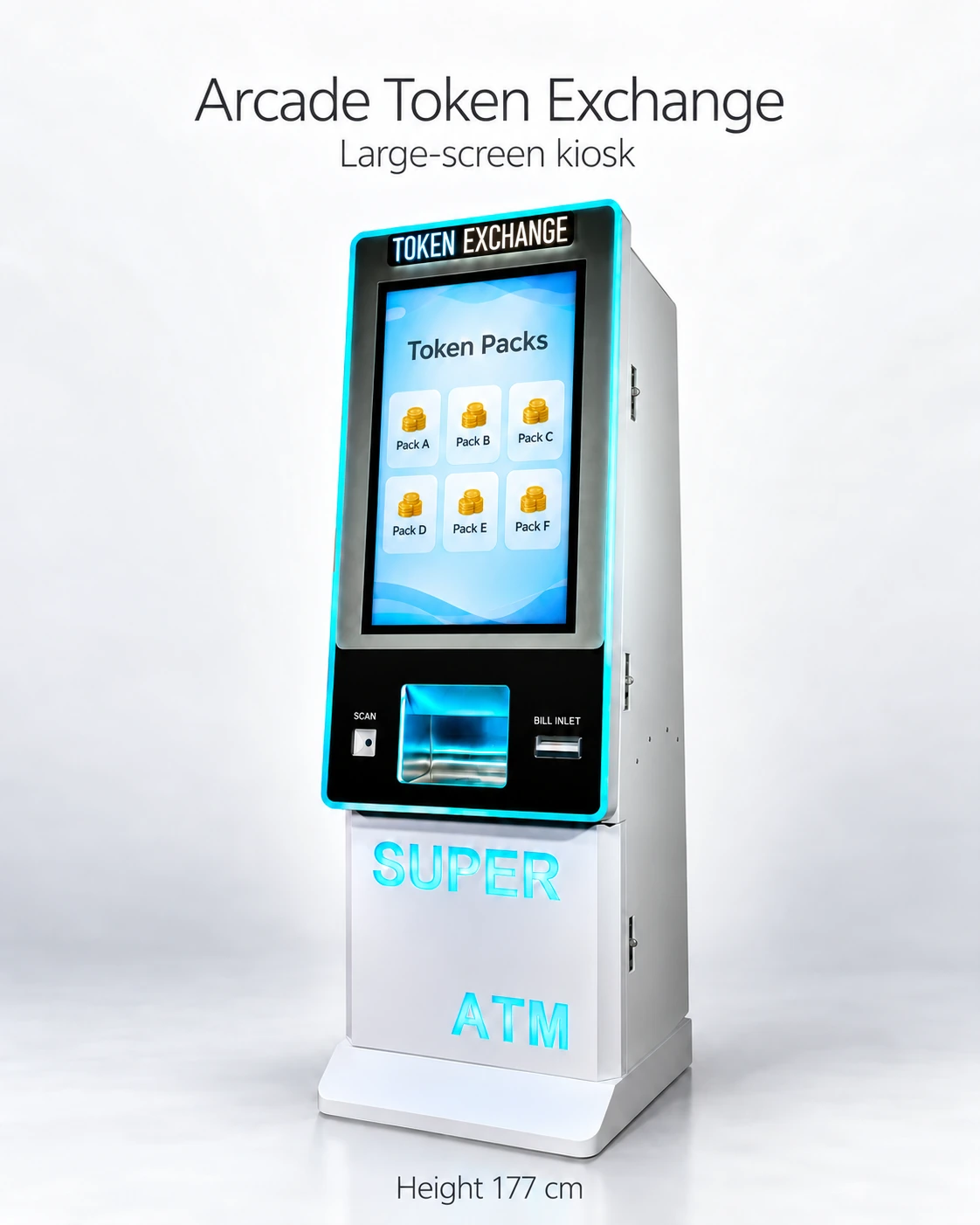
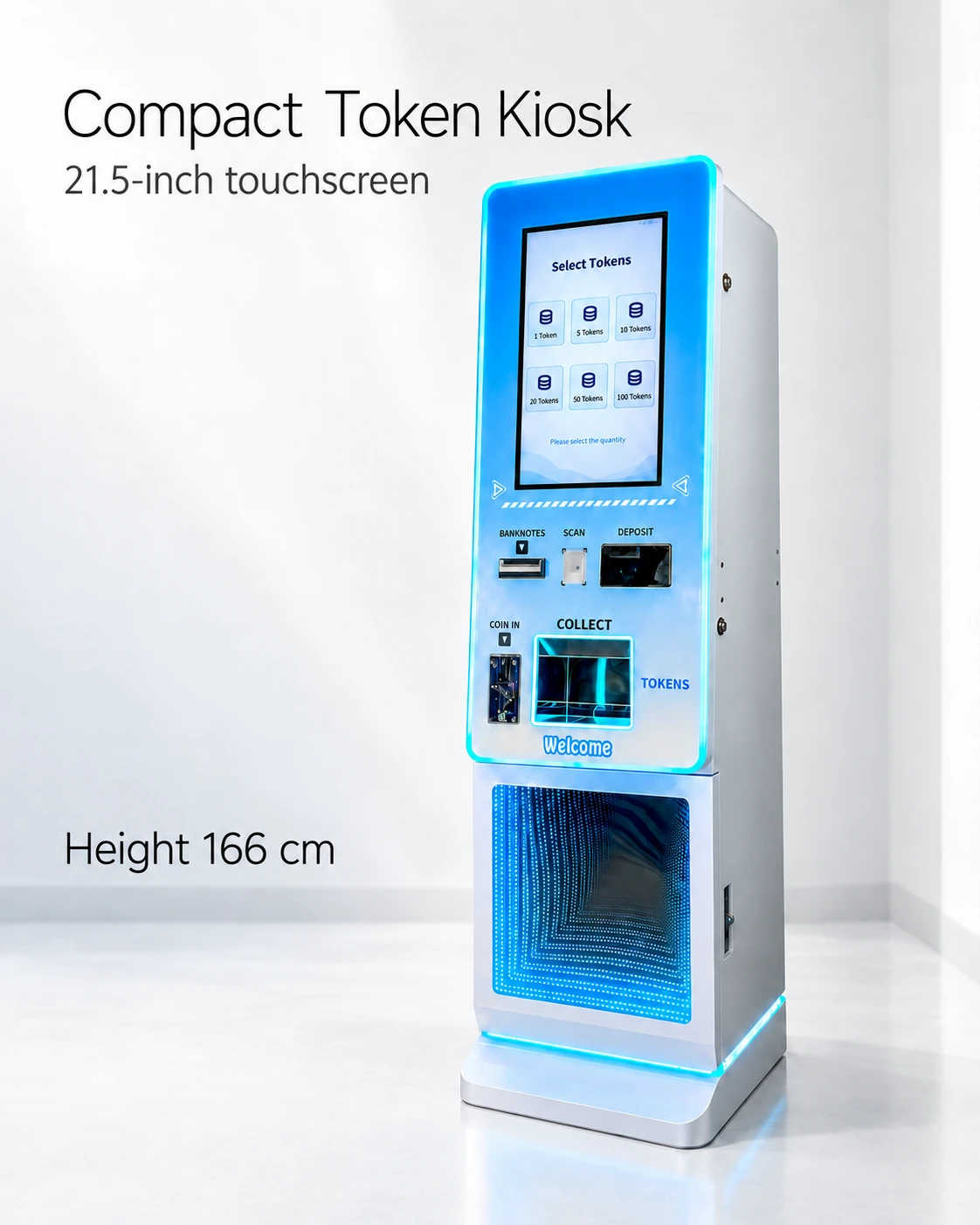
The table below outlines baseline catalogue specifications for reference token kiosks, where destination payment hardware, currency validators, and payment provider agreements remain unverified and require project-level confirmation.
Swipe across to compare all columns.
| Catalogue model | Cabinet dimensions (supplier-listed) | Supplier-stated payment modes |
|---|---|---|
| 32-Inch Touchscreen Token Exchange Kiosk | Cabinet size (supplier-listed): 58 × 63 × 177 cm (L × W × H as labeled on the source sheet) | The supplier lists QR, banknote and coin payment modes; overseas compatibility is not established. |
| 21.5-Inch Compact Token Vending Kiosk | Cabinet size (supplier-listed): 45 × 45 × 166 cm (L × W × H as labeled on the source sheet) | The supplier lists QR, banknote and coin modes; availability for any overseas service needs confirmation. |
Payment-reader packages, merchant gateways, and local regulatory certifications have not been verified for these baseline models. Buyers must specify their regional payment service and controller interface.
Establish Merchant Account Control and Portal Authority
Operational authority over a token kiosk's payment system does not reside on the kiosk motherboard or local touchscreen; it is governed through the provider's cloud management portal and merchant processing account. The party registered as the legal merchant of record controls settlement bank accounts, fee schedules, daily payout rules, and administrative portal access.
Buyers must confirm who establishes and owns the master operator account before equipment arrives on site. In factory-configured or distributor-managed systems, reader terminals may initially be tied to intermediary distributor accounts or test tenant environments. Attempting to redeploy or reassign a machine without administrative control over the provider account leaves the venue unable to update payout destinations, dispute chargebacks, or reconfigure vending packages.
Before taking delivery, obtain formal confirmation of the primary account credentials, administrative permission levels, and the exact process required to link reader serial numbers directly to the operating entity's designated banking profiles.
- Identify whether the primary provider account is held by the venue, the equipment distributor, or a third-party route operator.
- Confirm portal permissions required to modify settlement routing, view transaction audit logs, and trigger diagnostic resets.
- Verify the serial number binding procedure between the physical payment device and the venue's active merchant identification code.
Define Token Kiosk Card Reader Ownership Transfer Rules
When a venue changes operating entities, sells an arcade route, or transfers equipment to another concessionaire, executing a token kiosk card reader ownership transfer requires formal coordination with the payment gateway provider. Simply updating the physical venue address or physical possession of the cabinet does not transfer the payment processing relationship.
Payment providers enforce strict Know Your Customer (KYC), anti-money laundering, and underwriting criteria. Consequently, merchant processing agreements cannot be reassigned casually. For instance, commercial subscription agreements often mandate advance written notice before assigning contracts to a corporate successor, alongside formal assumption agreements signed by the incoming operator. If the successor fails to meet provider underwriting requirements or refuses to assume existing contractual terms, the originating operator may remain personally or corporately liable for unfulfilled contract balances.
A complete transfer protocol must define whether the existing gateway contract can be formally novated to the new entity or whether the reader terminal must be decommissioned, cleared of encryption keys, and reprovisioned under an entirely new merchant agreement.
- Determine provider notice periods and corporate documentation required to approve an operating entity reassignment.
- Establish whether contract assignment incurs administrative transfer fees, re-underwriting charges, or mandatory plan extensions.
- Verify the chain of liability: confirm in writing when the departing operator is formally released from financial obligations.
Audit Recurring Billing and Return Obligations for Idle Units
Unplugging a token kiosk or placing it into seasonal storage does not suspend recurring payment gateway, platform, or hardware subscription fees. Many cashless providers levy fixed weekly or monthly platform connection fees per terminal regardless of whether transactions occur.
In subscription arrangements like PayRange's commercial terms, recurring platform service fees continue to accrue during periods of non-use throughout the full plan term. If an operator unilaterally terminates an agreement before the term expires, remaining platform fees for the originally scheduled term may accelerate and become immediately payable. Furthermore, where hardware is leased or provided under a subscription, operators are typically required to return all physical hardware in undamaged condition within a designated return window at their own shipping expense, facing full retail replacement charges for missing or unreturned units.
Procurement teams must inspect provider contracts for dormancy clauses, minimum volume thresholds, offline penalties, and cancellation provisions before placing equipment into temporary storage or taking machines out of active service.
- Identify mandatory monthly or weekly connection charges that apply while the machine is disconnected from network power.
- Document early termination provisions, including fee acceleration clauses and hardware return deadlines.
- Clarify return logistics: identify responsible parties for return freight, transit insurance, and physical condition assessments.
Supplier and Provider Response Worksheet: Lifecycle Handover
Use the following procurement record during quote evaluation and operator transition planning. Each lifecycle requirement must be reviewed against written agreements provided by the equipment vendor and payment gateway provider.
This worksheet records configuration and commercial agreement boundaries; it does not serve as an electrical installation sign-off or substitute for formal financial underwriting.
Swipe across to compare all columns.
| Handover item and buyer question | Ordered kiosk model and configuration | Supplier and provider reply (terms / unknown / not applicable with reason) | Governing contract or written reference | Review status and designated reviewer |
|---|---|---|---|---|
| Reader title: Is the cashless reader transferred outright, leased, loaned, or subscription-provided? | [Enter kiosk model, serial number, and reader build] | [State title status: Sold / Leased / Subscription / Unknown / N/A with reason] | [Document ID, quote line item, or contract clause] | [Open / Hold / Resolved — Assigned Reviewer] |
| Portal ownership: Who creates, administers, and retains master credentials for the operator account? | [Enter kiosk model, serial number, and reader build] | [State master account holder and portal admin role] | [Platform agreement reference or account setup document] | [Open / Hold / Resolved — Assigned Reviewer] |
| Operator transfer: What written process and notice period are required to assign the reader to a new operating company? | [Enter kiosk model, serial number, and reader build] | [State required notice days, assignment form, or novation rule] | [Provider assignment policy or merchant agreement section] | [Open / Hold / Resolved — Assigned Reviewer] |
| Idle-period charges: What weekly or monthly service fees continue while the kiosk is unplugged or in storage? | [Enter kiosk model, serial number, and reader build] | [List active recurring fees during idle periods or confirm zero] | [Fee schedule reference or plan order form] | [Open / Hold / Resolved — Assigned Reviewer] |
| Termination and return: What conditions, return deadlines, and shipping costs apply if the service is terminated? | [Enter kiosk model, serial number, and reader build] | [State return deadline, retail fee for unreturned units, and freight responsibility] | [Plan termination and hardware warranty document] | [Open / Hold / Resolved — Assigned Reviewer] |
| Handover verification: What written close-out documentation confirms prior operator release and receiving account activation? | [Enter kiosk model, serial number, and reader build] | [State required sign-off form and provider release notice] | [Executed assignment agreement or terminal release letter] | [Open / Hold / Resolved — Assigned Reviewer] |
Hold condition: Place procurement or handover on hold if reader ownership, recurring subscription obligations, or account assignment terms are unspecified or in conflict with operating plans. Allow entries of unknown, not available, or not applicable when accompanied by an operational justification and named reviewer sign-off. Any post-order modification to kiosk configuration, payment reader model, or processor requires full re-confirmation across this worksheet before commissioning.
CHECK THE REFERENCES
Sources
- 32-Inch Touchscreen Token Exchange Kiosk reference configuration
Catalogue specifications and front interface layout.
- 21.5-Inch Compact Token Vending Kiosk reference configuration
Catalogue specifications and compact cabinet dimensions.
- PayRange Operator Agreement
Commercial subscription terms illustrating third-party reader ownership retention, recurring idle-period fees, hardware return terms, and contract assignment requirements. Used as an industry operating example; not the terms of catalogue kiosks.
PUT THE GUIDE TO WORK
Request build and payment agreement documentation
Submit your destination venue, intended kiosk model, and target payment provider. Request written confirmation of reader ownership, provider account assignment rules, and continuing idle-period fee schedules.
Build my equipment brief