Claw & prize machines
Types of Arcade Prize Machines: Claw, Clip and String Cutter
Choose claw, clip or string-cutting equipment around the actual prize. Compare three reference models, the sample test each needs and the configuration fields to lock before a batch order.
Choose the mechanism from the merchandise
Choose a claw machine for a prize that can be gripped loose in a bed, a clip prize machine for merchandise with an approved hanging attachment, and a string cutter for an approved suspended-prize arrangement. A claw machine is also commonly sold as a crane game. These are different loading and delivery tasks: the prize must fit the entire path from display to customer collection, whichever cabinet you shortlist.
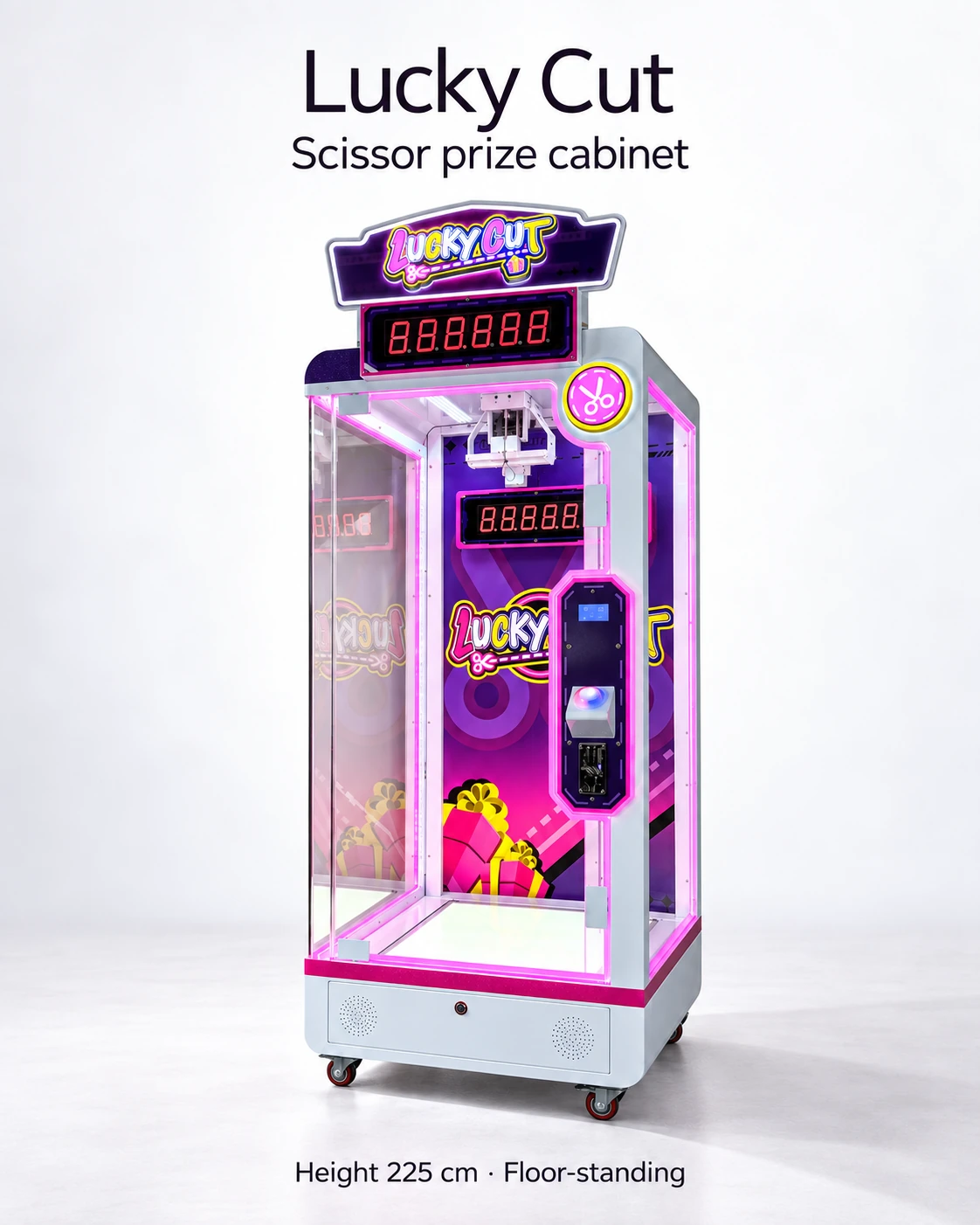
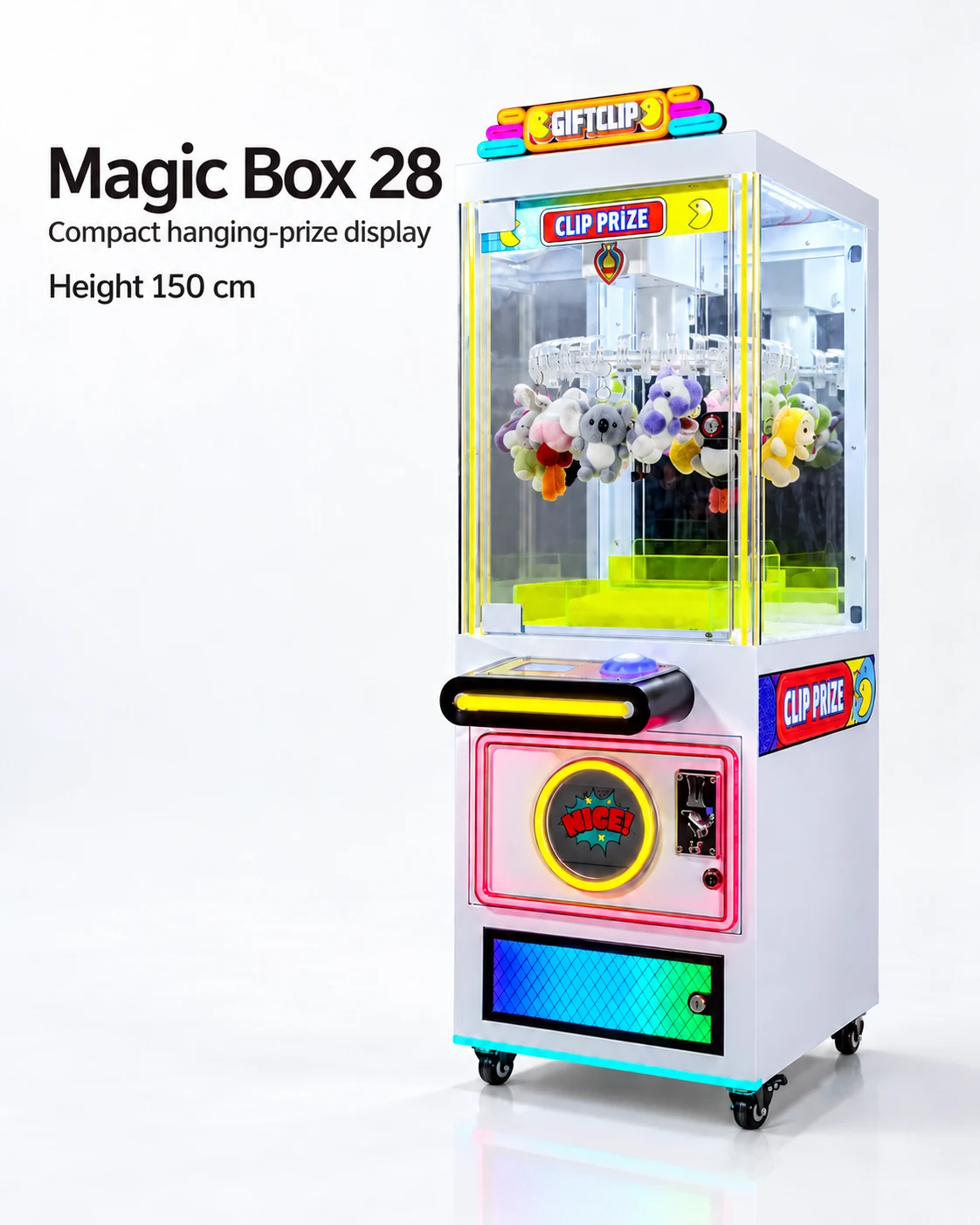
The Compact Single Claw uses a claw above a loose prize bed, the Magic Box 28-Clip displays hanging merchandise on a circular clip assembly, and Lucky Cut has a cutting mechanism above its prize chamber. These three layouts call for different packages and refill routines. Allowable prize loads and the collection path need to be matched to the chosen version.
Swipe across to compare all columns.
| Reference model | Prize presentation | Supplier-listed cabinet | Evidence to request before choosing |
|---|---|---|---|
| Compact Single Claw | Loose merchandise in a prize bed; a claw engages the item. | 50 × 61 × 150 cm; one player station. | Demonstrate your sample with the proposed claw, bed setup and usable collection outlet. Record failed grips and retrieval problems as well as completed plays. |
| Magic Box 28-Clip | Hanging merchandise on a circular clip assembly. | 50 × 61 × 150 cm; one player station and 28 clips. | Confirm the attachment and supported load for your sample, then demonstrate release, collection and staff reload. 28 clips does not mean 28 simultaneous players. |
| Lucky Cut Scissor | A suspended prize arrangement with a cutting mechanism. | 85 × 83 × 225 cm. | Confirm the approved cord, suspension and load, then demonstrate cutting, the complete collection path and reset. |
Dimensions are supplier-listed L × W × H on the reference sheets, not an installation drawing. Confirm the ordered build, projections, door openings and service clearance. No tested prize-load limit is supplied here.
Use this prize-format decision tree
Take one sample through the branches below. A yes answer identifies a candidate mechanism, not an approved configuration. If two branches fit, retain both candidates until a demonstration shows the complete prize path. If none fit, change the packaging or select a different machine rather than assuming a setting will solve a mechanical mismatch.
- Can the prize sit loose in a bed, be engaged by the proposed claw and travel through the outlet without damage? If yes, shortlist a claw model for a sample test.
- Does the prize have a supplier-approved hanging attachment that remains intact during display and releases cleanly? If yes, shortlist a clip model.
- Can the prize use the approved cord and suspension arrangement, with its load safely retained before the cutting cycle? If yes, shortlist a scissor model.
- For locked compartments, separate redemption or special handling, identify that collection mechanism in the quote as well as the visible prize display.
Compare the loading and collection requirements
A claw comparison needs the claw assembly, bed geometry and usable outlet dimensions. A clip comparison needs attachment requirements, load limits, spacing and a refill method. A scissor comparison needs the cord specification, suspension limits and reset steps. Use a complete loading-to-collection demonstration to see where the prize travels and where staff intervene.
Smart Industries' Ker Plop opens a prize clip with a timed actuator; its Mega Prize links a string-cutting action to a prize door. The contrast is useful when comparing offers: a successful release may drop the prize directly into an outlet or trigger a separate collection step. Include that step in the specification for your chosen model.
Keep the game rule separate from the hardware
Review the exact version's player sequence, price-to-credit mapping, play duration and operator settings alongside the mechanism. These determine what the customer buys and what staff can adjust. The proposed game rules, prize values and customer disclosures also belong in the destination review.
Clip positions describe display stock; player stations describe places to play. Compare compatible merchandise, usable stations and refill work separately. Choose the mechanism that delivers your intended merchandise through a repeatable process customers can understand.
Use a configuration sheet before ordering a batch
A successful sample test answers whether that prize and setup work together. A batch order needs a second check: which settings and parts repeat across machines, and which change by location or market. Use one revision-controlled line per configuration instead of describing a mixed order as “the same machine”.
For an operator, group machines by the prize family and venue conditions. For a distributor, separate the destination, payment build, artwork and service pack for each customer group. Ask the quote to identify any different lead time, cost or minimum quantity; these terms are not fixed by the catalogue.
Swipe across to compare all columns.
| Field | Buyer supplies | Supplier confirms | Keep with the order |
|---|---|---|---|
| Model and quantity | Reference model, units per configuration and destination. | Exact model/version, quantity and any substitution for approval. | Dated quote line and configuration revision. |
| Prize family | Sample ID, packed dimensions, mass, surface or hanging attachment. | Approved claw, clip or cord setup; load and collection limits for that sample. | Sample photos and complete loading-to-collection demonstration. |
| Game and payment | Currency or tokens, local cashless request and intended player sequence. | Supported payment hardware, price-to-credit mapping and operator settings. | Payment and play acceptance checklist for the ordered version. |
| Electrical and placement | Destination supply, receiving route and planned service space. | Input version, frequency, plug, grounding, dimensions and clearance. | Installation drawing and electrical specification; do not assume a range means automatic voltage switching. |
| Artwork and language | Approved files, customer-facing language and per-location differences. | Printable areas, file requirements and the final artwork proof. | Approved artwork version matched to each quote line. |
| Service and receiving | Local support contact, receiving access and required spare-parts scope. | Available manuals, spare parts, packing data and agreed support responsibilities. | Handover checklist, package list and support terms. |
This is a purchasing template, not a pre-approved configuration. Confirm the sample result and quotation before repeating a setup across a batch.
CHECK THE REFERENCES
Sources
- Compact Single Claw Machine reference configuration
Supplier catalogue configuration reference.
- Magic Box Clip Prize Machine — 28 Clips reference configuration
Supplier catalogue configuration reference.
- Lucky Cut Scissor Prize Machine reference configuration
Supplier catalogue configuration reference.
- Smart Industries self-merchandiser mechanisms
Manufacturer descriptions of Ker Plop clip release and Mega Prize string-cutting delivery.
PUT THE GUIDE TO WORK
Match the machine to your prize — then build the batch
Send your prize photos, packed dimensions, mass, machine quantities and destination. We can bring the candidate models, sample-test questions and per-market configuration into one quotation discussion.
Build my equipment brief