Food vending
Ice Cream vs Shaved Ice vs Slush Vending Machines: Which Workflow Fits?
Compare freshly prepared ice cream, shaved ice and slush vending by ingredient supply, cups, menu hardware, space and unresolved operating requirements.
Choose the serving before the cabinet
Choose between ice cream, shaved ice and slush vending machines by the product customers will receive and the supply workflow the venue can support. A cup dessert with sauce and toppings, a shaved-ice dessert and a frozen drink create different ingredient, cup and service requirements.
First decide whether the offer is prepared at the machine or dispensed as a packaged frozen product. The catalog candidates here are preparation formats. Packaged ice cream bars and similar products need a different freezer-vending shortlist; this guide does not establish that the three preparation cabinets support that format.
Compare the three catalog formats
The following dimensions, capacities and ingredient positions are supplier-listed references. Vessel volume and cup stock are starting configuration fields; usable fills and serving quantities depend on the accepted ingredients, cups and recipes.
- Ice cream: 100 × 81 × 219 cm; one base mix, three sauce positions and three topping positions; listed 12 L base vessel; up to 200 plastic or 300 paper cups, with exact cup specifications unresolved.
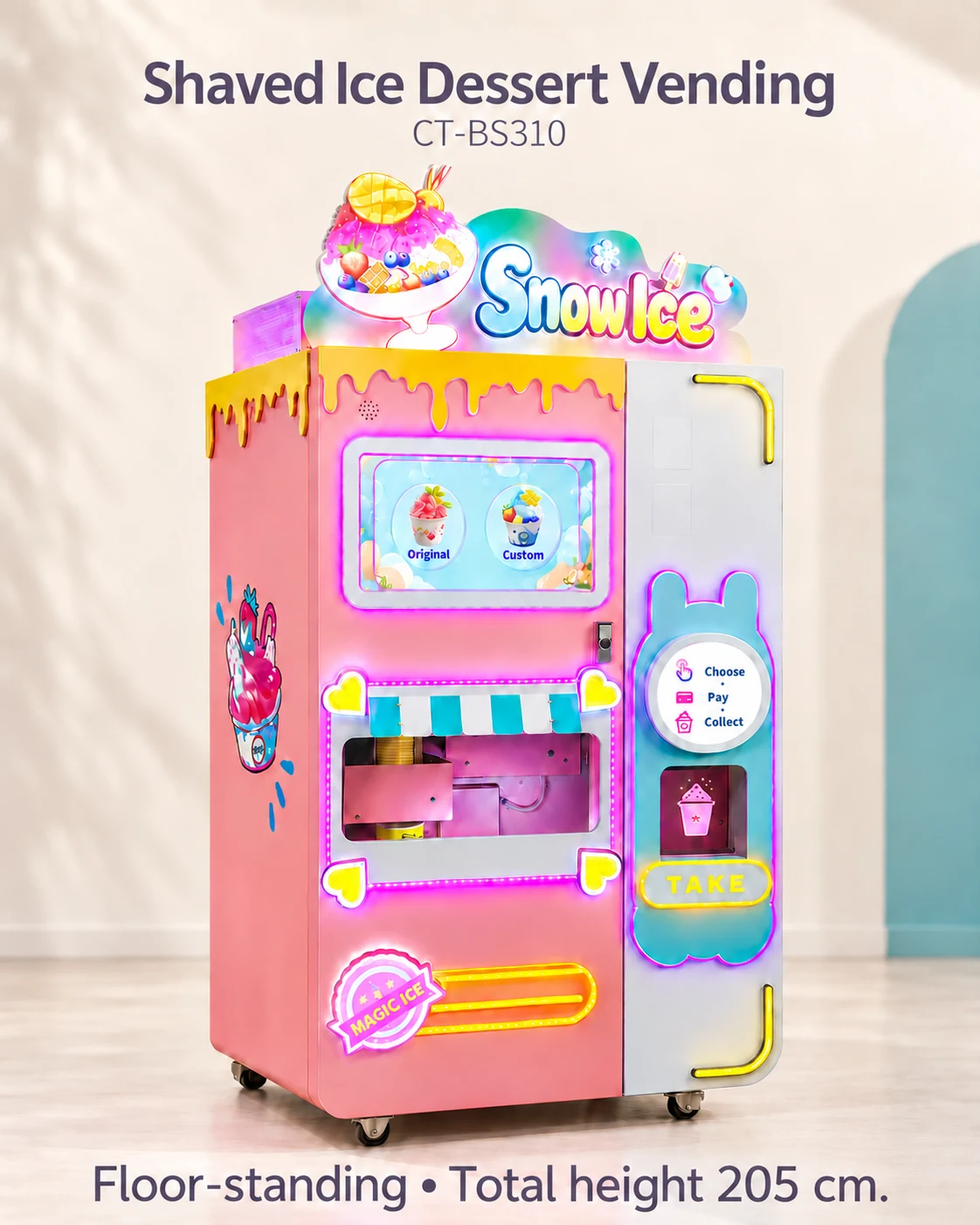
- Shaved ice: 105.5 × 85.5 × 205 cm; one base, two sauce positions and two topping positions; listed 12 L base vessel; approximately 70 paper cups. The dedicated source leaves the freezing/shaving mechanism and power rating unresolved.
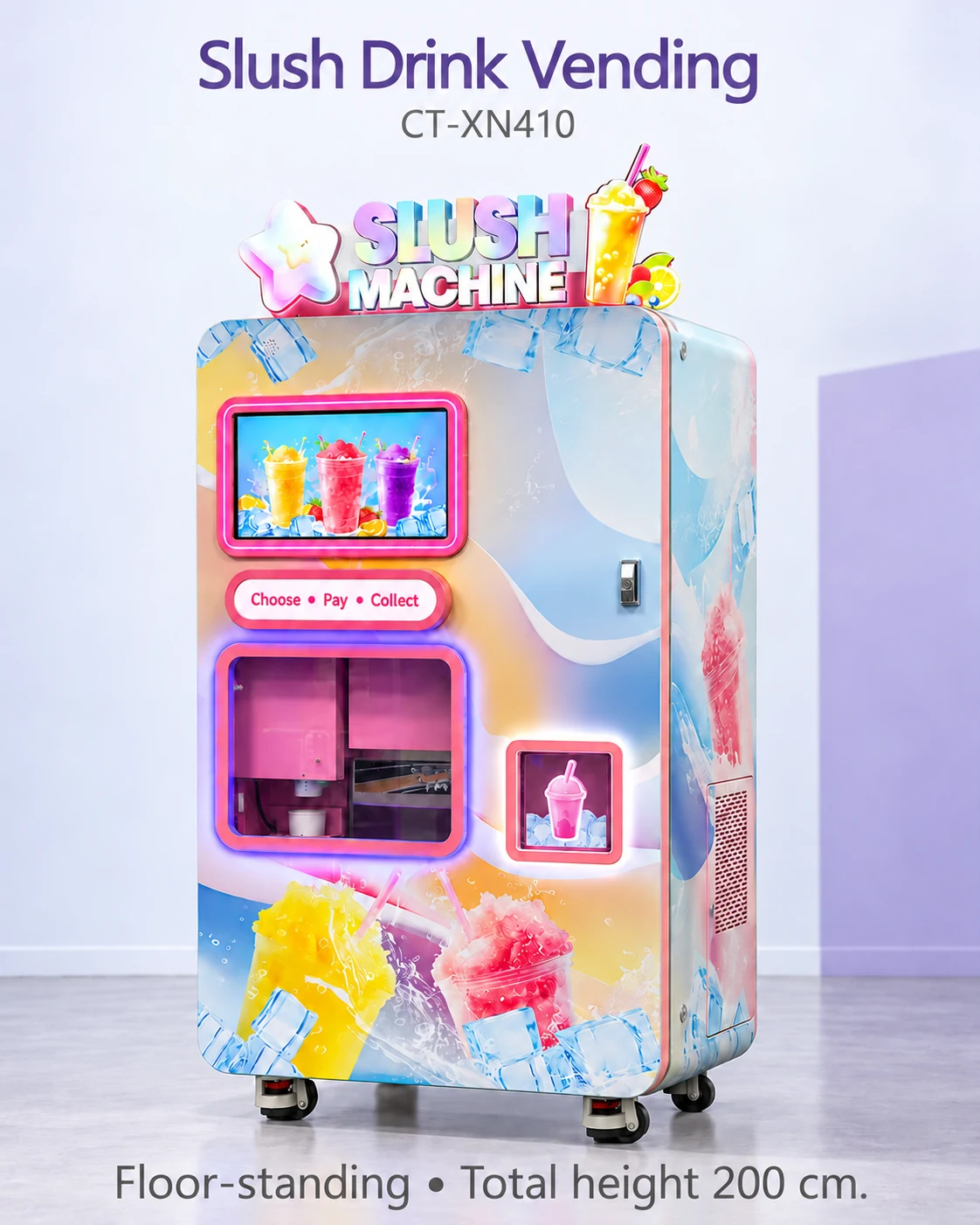
- Slush: 101 × 66 × 200 cm, interpreted as front width, depth and height; two base positions and three topping positions; a supplier card describes 12 L + 12 L reservoirs. Cup and screen figures conflict across supplied cards.
Match the menu to the ingredient route
Ice cream is the relevant shortlist for a cup dessert built around a compatible base, sauces and toppings. Start with a small opening menu and map each recipe to an accepted ingredient code and cup. The count of positions helps organize the menu; the supplier’s supported combinations define what can actually be offered.
Shaved ice belongs on the shortlist when that dessert texture is the central offer. Before buying ingredients, establish the catalog machine’s preparation mechanism and required input. The unresolved source does not identify whether it uses ice blocks or another process.
Slush is the drink-format shortlist. Its two base positions can organize the planned offer, but the approved preparation method, usable reservoir loads, cup and local supply route determine the opening stock. Keep dilution and recipe settings with the supplier-approved product.
Compare a normal service day
For each candidate, trace receiving, storage, any preparation, loading, serving, collection, cleaning and support. Add the person, facility and instruction needed at each stage. This exposes a practical difference between a menu the venue wants and a workflow it can accommodate.
In a hypothetical retail corner, a drink menu may fit the commercial offer while ingredient preparation or cleaning space remains unavailable. Resolve the supply or facility arrangement before expanding the menu. A larger vessel cannot close that resource gap.
- Decision fields: desired serving; ingredient source; preparation method; accepted cup; usable stock; site facilities; task owner; outstanding configuration item.
- Pilot fields: completed paid servings; unavailable time; ingredient and cup use; rejects; staff work; customer collection observations.
Make the first order specific
A comparable quote names the opening recipes, accepted ingredients and cup sample, electrical build, service resources and included handover. Use a bounded venue pilot to replace stock and labor assumptions with observations before buying additional units.
Ice cream cabinet: connect the recipe to a completed paid cup
For the reference cabinet listed at 100 × 81 × 219 cm, identify the exact build, cup magazine and opening recipe in the quotation. Its one base, three sauce positions and three topping positions are configuration references, not a promise that every ingredient or combination works. Keep the listed 200 plastic or 300 paper cups separate from the actual demonstrated load and ingredient yield.
Ask for a continuous demonstration of selection, payment, single-cup release, base and selected additions, then collection of the finished serving. Record the recipe, cup code, final output and any intervention. Include an authorised demonstration of a missing cup or unavailable ingredient and how an already-paid order is resolved. The cup-fit guide supplies the detailed sample log; the machine purchase should retain the accepted result and the responsible support party.
Shaved-ice cabinet: resolve the preparation method before buying stock
For the reference listed at 105.5 × 85.5 × 205 cm, have the supplier name and demonstrate the actual preparation mechanism and required input on the quoted unit. The supplied specification leaves that mechanism and power rating unresolved. Do not buy ice blocks, premix or another input on the assumption that a different shaved-ice machine uses it.
Use the approved input, cup and opening recipe to observe preparation, the selected sauce and topping, payment and collection as one order. Confirm the operating sequence before testing it; the listed 12 L vessel and approximately 70 paper cups do not establish throughput. Request the authorised cleaning, remaining-product handling and restart instructions, plus the response to an interrupted paid serving. Assign the operator and equipment service tasks before approving the purchase.
Slush cabinet: approve both drink paths and the final configuration
For the reference listed at 101 × 66 × 200 cm, compare the two base positions and three topping positions against the actual opening drinks. The separate 12 L + 12 L reservoir description is not an accepted serving count. Resolve the 70-versus-80 cup and 21-versus-21.5-inch display discrepancies in the final build schedule rather than selecting the larger number.
Demonstrate each proposed base with its approved preparation method, cup and portion settings, including payment and customer collection. Ask what the customer sees when one base or the cup stock is unavailable and how an interrupted paid order is reconciled. Request the cleaning and product-change procedure for each fluid path, with the permitted operator tasks and required service work identified. Keep the accepted recipe and any substitute ingredient approval with the supplied software version.
Make the cooling arrangement part of the ice cream quotation
For the ice cream option, ask the supplier to identify how the quoted build removes heat and which matching installation document defines its site requirements. Do not assume the cabinet is air-cooled, that a water-cooled alternative is offered, or that cooling water is the same supply used for ingredients or cleaning. The cooling arrangement for CT-GX210 remains unconfirmed.
Taylor’s soft-serve guidance distinguishes equipment that rejects heat into the room from equipment that carries it away through cooling water. It also identifies water-supply and drain connections, local water and sewage costs, and the difficulty of changing condenser configurations later. These are reasons to resolve the installation and service scope before ordering; they are not specifications or available options for the reference vending cabinet.
Give the supplier’s actual requirements and the proposed layout to the responsible site professional. Record any venue work, utility provision and continuing service that must be priced, who supplies it, and which costs are excluded from the cabinet offer. Keep the cooling utility separate from drink ingredients and cleaning services so that an included water accessory is not mistaken for a complete installation scope.
If a move to another site is part of the buying plan, ask the supplier whether that same build can serve the proposed new conditions and what documented changes would be required. Do not assume a change of cooling system is an operator setting. Compare the quotation only for the arrangement that the supplier and site reviewer have actually addressed; retain unresolved material items with an answer owner.
Swipe across to compare all columns.
| Purchase decision | Supplier or site response | Evidence, cost scope and next owner |
|---|---|---|
| What cooling build is actually quoted? | [Fill: machine/build and quoted cooling arrangement; matching manufacturer document; available alternative only if confirmed] | [Fill: quote/document reference and date; unknown or conflicting item; answer owner] |
| What does the venue have to provide? | [Fill: supplier-required site conditions and applicable utility arrangement; responsible site reviewer response] | [Fill: dated site-work quotation; included/excluded scope; ongoing utility or service cost basis; owner] |
| Does a planned relocation change the order? | [Fill: proposed later site, if relevant; supplier response for the same build; required change or alternative order scope] | [Fill: written feasibility response; separate change cost where quoted; unresolved decision and owner] |
Complete for the selected ice cream proposal and its destination. Unknown, Not available and Not applicable with a reason are allowed. This record does not supply installation instructions, clearances, utility rates or a completed site approval. It does not establish any reference model’s cooling system or conversion capability.
Close the site and service scope for the chosen food cabinet
Request the exact input voltage, mains frequency, plug, electrical rating basis and installation drawing for the chosen build. Body dimensions do not include confirmed service clearance or the receiving route. Have the responsible site and food-service parties review storage and serving conditions, temperature checks, cleaning facilities, waste handling and the approved response to a temperature deviation or interruption; no universal operating threshold is established here.
Ask for separate prices for the cabinet, opening ingredients and cups, payment work, software fees, training, spare parts, packing and freight. Assign unloading, installation, local service labour and replacement-part freight. Obtain the actual package dimensions and gross weights, delivery schedule and warranty terms before comparing the total offer.
CHECK THE REFERENCES
Sources
- Taylor — Air-Cooled vs. Water-Cooled Soft Serve: Which Is Right for Your Shop?
Manufacturer guidance on cooling configuration, installation dependencies and water/sewage cost questions for Taylor soft-serve equipment; no CT-GX210 specification, option or performance is established.
PUT THE GUIDE TO WORK
Shortlist a dessert or drink format
Tell us the product you want to serve, destination and venue. Share known ingredient sources, available space and the formats you want compared.
Build my equipment brief